One of the consequential strategic questions in any contested family law case is whether to take the case to trial or to settle. Most cases settle — even most high-conflict cases. Some have to be tried. Knowing which kind of case you have, and choosing accordingly, is critical.
This article walks through the strategic calculus for both paths in the specific context of a high-conflict case. The right answer for your case is jurisdiction-specific, fact-specific, and attorney-advised — but the framework here will help you evaluate the trade-offs honestly.
The case for settlement
A negotiated settlement, when it works, has real advantages:
Speed
Cases that settle resolve in months instead of years. The case itself is part of the harm — the longer it goes, the more emotional, financial, and parenting damage accumulates. Speed is value.
Cost
A contested trial in a high-conflict case can run from tens of thousands to hundreds of thousands of dollars in attorney fees, expert fees, and related costs. Settlement avoids most of that. Even a settlement on suboptimal terms is sometimes net-positive once you account for the cost of trying for better terms.
Predictability
You know what you're getting. A trial outcome depends on the judge, the evidence, the witnesses, the day, the mood in the courtroom. A judge's ruling can be worse than a negotiated outcome you would have accepted. The variance at trial is real.
Customization
Negotiated terms can include arrangements that a court could not order on its own. Specific decision-making protocols, specific communication structures, specific dispute-resolution mechanisms, specific division of holidays and vacations, specific provisions for unusual family situations. The flexibility is significant.
Preserves some functional relationship
To the extent there is any prospect of functional coparenting after the case, a negotiated settlement often preserves more capacity for that than a contested trial. Trials produce winners and losers and resentments that last for years.
Children outside the worst of it
The children are mostly spared the most painful parts of trial — the testimony, the cross-examination, the rulings. Cases that settle leave less trauma in the family system.
The case for trial
Sometimes settlement is not the right move:
Safety issues
If there are genuine safety concerns — documented abuse, substance use that endangers the children, untreated mental illness affecting parenting — you may need a court order with specific protections that the other side will not negotiate. Trial may be the only path.
The other side won't negotiate in good faith
If the HCP's negotiating posture is "give me everything I want," and there is no realistic settlement available, then trial is not optional. You are going to trial either way; the question is when. Sooner is usually better than later.
You need findings, not just orders
Settlements produce orders. Trials produce findings of fact. In some cases — alienation cases, abuse cases, financial-misconduct cases — the formal finding of fact has independent value beyond the order it supports. A trial finding is admissible in future proceedings; a settlement is not, in the same way.
The pattern needs to be broken
In some chronic high-conflict cases, settlement just kicks the can. Three months later the same fight returns under a new motion. A trial — with a clear order and a clear ruling on the underlying dynamics — sometimes does what no settlement can do: definitively establish what is in fact going on, and constrain future motions accordingly.
The leverage is yours
If your case is genuinely strong — the documentation is solid, the witnesses are credible, the other side has dug themselves a hole — trial may produce a meaningfully better outcome than any settlement they will agree to. Their settlement posture is constrained by their pride and their HCP framing; a judge's ruling is not.
The hidden settlement question: enforceability
One thing that gets overlooked: a negotiated settlement is only as good as your ability to enforce it. Settlements with HCPs sometimes fall apart because the HCP simply doesn't comply — and now you have to file motions to enforce, hearings to compel, contempt proceedings to punish. The settlement saved you the trial, but the post-judgment enforcement costs more than the trial would have.
If you are considering settlement, evaluate honestly:
- Will the other side actually comply with the terms?
- Are the terms specific enough to be enforceable?
- Are there built-in enforcement mechanisms (parenting coordinator, automatic make-up time, fee-shifting for breach)?
- Is there a history of compliance with previous orders, or a history of selective non-compliance?
If the answers suggest the settlement won't be honored without ongoing court intervention, the settlement is not actually saving you the trial. It's deferring it.
The hidden trial question: cost-to-improvement ratio
Conversely, the trial-versus-settle calculus often comes down to: how much better are you likely to do at trial, and how much will it cost to find out?
If a fair settlement would give you 80% of what trial might produce, and trial would cost an additional $75,000 in fees and six more months of litigation, settlement is the right call even though trial offers a better outcome. The marginal improvement is not worth the marginal cost.
If a fair settlement is on offer at 30% of what trial might produce, the calculation flips. The cost of trial is real but the gap is large enough that going to trial is rational even after accounting for variance and cost.
The honest assessment of this gap is your attorney's job — not yours, not your therapist's, not your friends'. A good attorney can give you a realistic range of likely outcomes, the probability distribution within that range, and the cost of getting from settlement to trial. Make the decision on that information, not on your emotional state.
The decision framework
A working set of questions for the settle-or-try decision:
- What is the realistic range of outcomes at trial? What is the most likely outcome?
- What is the realistic range of outcomes via settlement? What is the best settlement offer likely to be?
- What is the gap between the two? Is it large enough to justify the cost of getting it?
- What is the cost of trial — fees, time, emotional toll, impact on children?
- Is there a genuine safety issue that requires court order?
- Will any settlement be honored, or will I be back in court enforcing it?
- Do I need findings of fact for future enforceability?
- What does my attorney recommend, and what is their reasoning?
None of these have universal answers. They have your-case answers. The exercise of working through them is the exercise.
The emotional trap
One warning: do not let "I want my day in court" drive a decision that should be made on cost and outcome. Many protective parents in high-conflict cases want, badly, to be heard — to have a neutral third party finally see what they have been seeing for years. Trial offers that. It is one of the few moments in the entire system that does.
This desire is real and not contemptible. But it can produce trial decisions that are not in your long-term interest. The "day in court" is often less satisfying than expected, more expensive than expected, and not actually better for the children than a structured settlement would have been.
If you find yourself driving toward trial primarily because you want to be heard, talk to your therapist. Find another forum for being heard. Don't burn the case decision on the emotional need.
If you settle
Then settle as if it has to last forever. Specific terms. Built-in enforcement. Realistic implementation. Don't let "we just want to be done" produce a settlement that you'll be in court litigating six months later.
If you try
Then prepare as if it's the only chance you get. Because it largely is. Your documentation file, your witness list, your attorney's preparation, your own readiness for testimony — all of it has to be at its best. Trials are not won by hope or by righteousness. They are won by preparation that started six months before the date on the calendar.
Want the full playbook?
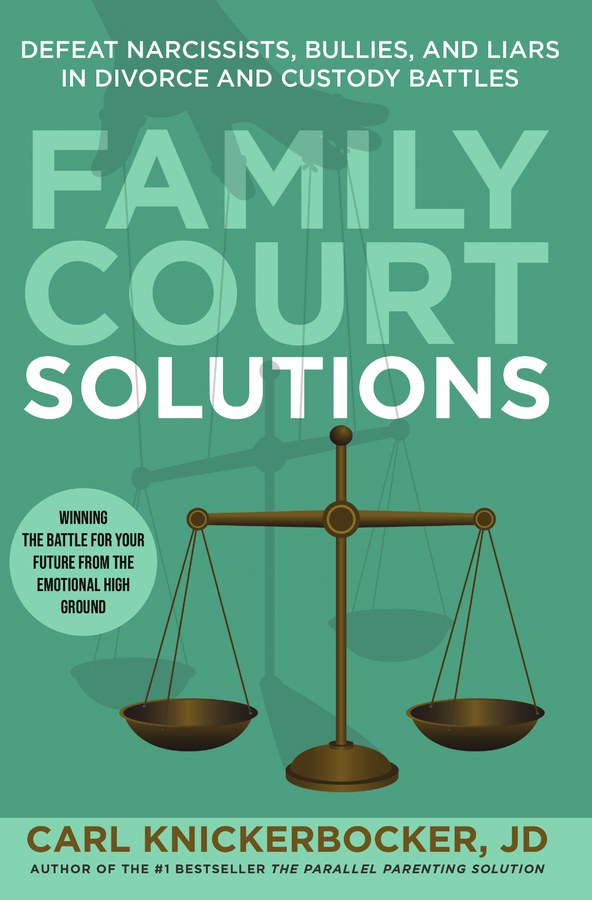
This article is adapted from Family Court Solutions by Carl Knickerbocker, JD — the therapist-recommended, attorney-written guide to defeating narcissists, bullies, and liars in divorce and custody battles.
Get the Book