By Carl Knickerbocker, JD
From book to case file.
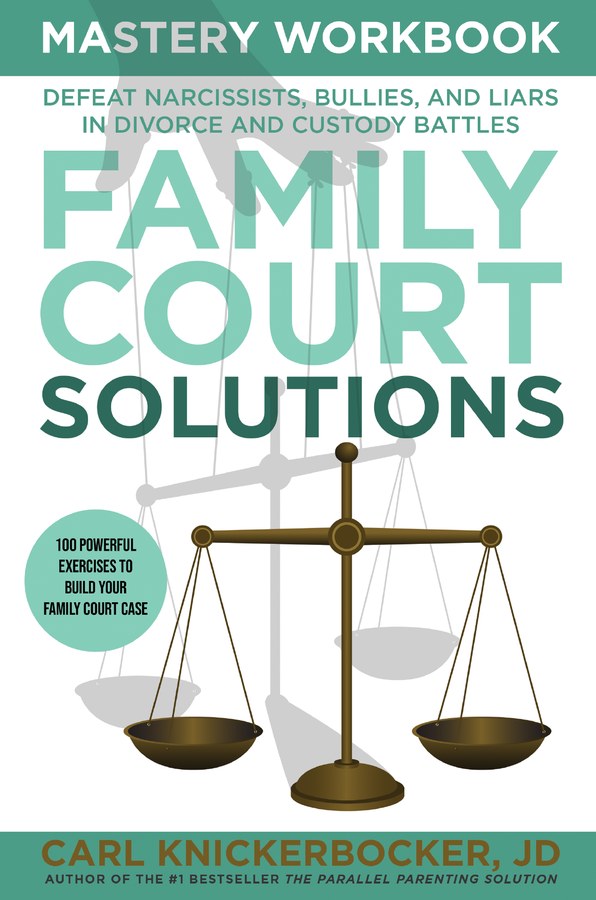
The official companion to Family Court Solutions — 100 powerful exercises designed to take you from "I read the book" to "I have a documented, organized, court-ready case."
100 powerful exercises designed to translate Family Court Solutions into a buildable case file. The official companion for parents in active litigation — or anyone who senses litigation is coming and wants to be ready.
The official companion to Family Court Solutions — 100 powerful exercises designed to take you from "I read the book" to "I have a documented, organized, court-ready case."
Family Court Solutions lays out the playbook. The framework, the tactics, the counter-tactics, the cross-examination notes, the mental health chapter that gets re-read more than any other. For some readers, that's enough — they put the book down and start applying it.
For others, finishing the book raises a different question. Where do I actually begin? The case feels like a thousand moving parts. The other side has been running a campaign for years and you're trying to assemble a coherent record from texts, screenshots, voicemails, court orders, school emails, witness memories, and your own scrambled notes. You know what to do. You don't know what to do first.
That's what the workbook is for. Each exercise is a guided, structured task — pulling apart a specific piece of your case, organizing it, and slotting it into a file that an attorney, GAL, or judge can actually read. You stop staring at the pile. You start building the case.
Organized around the six chapters of the book — tactical, sequential, and built for parents in real cases.
Mapping the high-conflict traits and behaviors you're actually dealing with — with concrete examples from your own case — so you stop debating whether it's "really that bad" and start documenting what is.
Naming the manipulation tactics you've been on the receiving end of: gaslighting, projection, triangulation, smear campaigns, false allegations. One exercise per tactic, with prompts to log specific instances.
Pulling your existing records into shape: communication logs, custody journals, financial documentation, school and medical records. What you have, what's missing, and what to start collecting now.
Auditing your own messages and responses with the cold eye a judge will. What works, what looks bad on paper, and how to adjust before the next exchange becomes the next exhibit.
Defining specific, achievable objectives for your case — what you're actually asking the court to do, what's realistic given your jurisdiction and facts, and what you're willing to compromise on.
Anticipating the questions the other side will ask you, drafting honest answers, and identifying the documented evidence that supports your position. Bring this to your attorney.
Identifying the specific stimuli — certain phrases, dates, places, behaviors — that pull you out of regulation, and building the regulation strategy that lets you respond instead of react.
Sleep, support systems, mindfulness, and the daily practices that keep you intact for the marathon. Not optional — the chapter the book is most insistent about.
Looking past the case — what you want your life and your kids' lives to look like in one year, five years, ten. The vision exercise that anchors every other decision in the book.
Most readers move through the workbook in the rhythm their case allows — sometimes a few exercises in a focused weekend, sometimes one a week between hearings, sometimes a single exercise the night before a deposition because that's the one that fits the question.
The exercises are sequenced to build on each other, but you don't have to do them in order. Use the table of contents like a menu, not a recipe. If a hearing is two weeks out and you need cross-examination prep, go straight there. If a smear campaign just lit up Facebook, the documentation exercises for that come earlier in the book.
Each exercise has the same structure: a brief explanation, a guided series of prompts, and space to write down what you find. The output is yours — it goes in your case file, in your therapist's office, in your attorney's hands, or in your own private notebook depending on what it is and what you want to do with it.
If you're working with a therapist or attorney, the workbook doubles as session material. Bringing a completed exercise to a session can make 50 minutes of therapy or an attorney conference more productive than two hours of unstructured talk.
Reading the book gives you the playbook. The workbook is how you actually build the case.— On using the Mastery Workbook
The original book is a six-chapter read-through — the framework, the tactics, the courtroom strategy. The workbook is a 100-exercise practice that translates it into a real case file.
The framework. Read it once for orientation, then keep it on the desk for the chapter-by-chapter reference you'll come back to before every hearing.
Buy the BookThe practice. 100 exercises that translate the book into documented evidence, organized records, and a court-ready case file.
Buy the WorkbookThe workbook is available in print on Amazon. Pair it with the book for the full system — framework and practice, playbook and case file.