If you remember nothing else from Family Court Solutions, remember this: emotional regulation is not just a personal-wellness goal in high-conflict family law. It is one of the most important things the judge is evaluating about you.
That sentence reframes a lot. The breathing exercises, the mindfulness practices, the careful attention to sleep and nutrition — these are not just self-care. They are case strategy. The parent who shows up to court regulated, calm, and articulate is doing something the high-conflict parent generally cannot do. And judges notice.
What judges actually evaluate
Family court judges have an extraordinarily difficult job. They are asked, on the basis of limited information collected under adversarial conditions, to make decisions that will shape children's lives for years. They cannot crawl inside your family. They cannot interview the kids in any meaningful way. They cannot watch you parent over time. They have to evaluate, in a few hours of testimony and a stack of paperwork, which of two parents is more likely to provide the stable, child-focused environment the children need.
One of the most important data points they have for that question is how each parent behaves under stress. Specifically, under the stress of being challenged in court.
If you cannot manage your emotions in front of the judge — with your attorney sitting next to you and the cameras of the system pointed at you — what does that imply about how you manage your emotions in your kitchen at 7pm on a Tuesday with a tired six-year-old in front of you? The judge will not say that out loud, but the inference is unavoidable.
Conversely, the parent who can sit through a brutal cross-examination — lies, accusations, provocations — and respond with composure, accuracy, and honesty is doing something specific in front of the judge. They are demonstrating, in real time, the kind of nervous system you'd want managing your kids.
Why HCPs cannot do this
This is one of the structural advantages a protective parent has in high-conflict family court, properly understood. The very personality traits that make the high-conflict ex impossible to coparent with — hypersensitivity to criticism, inability to tolerate contradiction, reflexive blame-shifting, fragile self-esteem — are the same traits that destroy them on the witness stand.
You cannot fake regulation. You can perform calm for a few minutes, but sustained calm under sustained pressure is a function of an actual nervous system, not a performance. The HCP's nervous system was the central problem of the marriage. It is also going to be the central problem of their testimony.
Your job is to show up to court with a different nervous system. That is not a thing you can do at 9am on the morning of trial. It's a thing you build over months.
The practices that build it
Sleep first, everything else second
Adults need 7-9 hours. Sustained sleep deprivation impairs cognitive function, emotional regulation, and verbal recall — all the things you most need in court. If you can fix only one thing about your physical state during litigation, fix sleep. Establish a consistent bedtime. Protect it.
Identify your triggers
Most protective parents in high-conflict cases have a small set of trigger topics that reliably destabilize them — specific accusations, specific phrases, specific moves. Identify them. Name them in advance. Practice the regulated response so it is rehearsed by the time it shows up in cross-examination.
Practice the pause
The single most important micro-skill in court testimony: a deliberate pause before answering. Three seconds. Long enough to register the question, register your reaction, choose your response. The pause looks thoughtful, not slow. It is the difference between testimony that is calm and testimony that is reactive.
A consistent body
Body language and emotional state co-regulate. If you sit straight, breathe slowly, keep your hands still, and maintain neutral eye contact, your nervous system follows. If you fidget, slump, or tense, your nervous system follows that instead. Practice the body posture you want to bring to court — in your living room, in your car, at the dinner table — until it is your default.
Therapy with someone who understands high-conflict dynamics
Generic therapy is not enough. You need a clinician who recognizes narcissistic abuse, betrayal trauma, complex PTSD, and the specific dynamics of high-conflict coparenting. The wrong therapist will reframe your entirely accurate observations as "still being angry from the divorce" and slow you down. The right one will help you build the regulated nervous system your case requires.
A support system that does not require performance
One or two trusted people who get the situation, will listen without judgment, and will not need you to be okay in their presence. The energy spent maintaining a face for less-trusted listeners is energy you cannot spend in court.
What to stop doing
- Stop doom-scrolling at night. The nervous system you bring to bed is the nervous system you wake up with.
- Stop relitigating in your head. The internal rehearsal of every grievance is its own trauma loop. It is not the same as preparing.
- Stop reading every text from your ex the moment it arrives. Designate windows. Read inside them. Outside them, you do not check.
- Stop using alcohol to manage the stress. It will catch up with you. Often at exactly the wrong moment.
- Stop performing wellness. Real regulation requires admitting how dysregulated you actually are. The performance of being fine costs you the resources you need to actually become fine.
The reframe
Composure is not the absence of emotion. It is not pretending you are not affected. It is not stoicism. It is the deliberate, sustained, practiced ability to feel everything you are feeling and still respond from a place of strategy rather than reaction.
Your high-conflict ex cannot do this. The judge knows it. Your job is to make the difference between you visible — not by claiming the difference, but by embodying it. Months of patient nervous-system work, made visible across a single afternoon of testimony, is one of the most persuasive presentations a family court will see.
Want the full playbook?
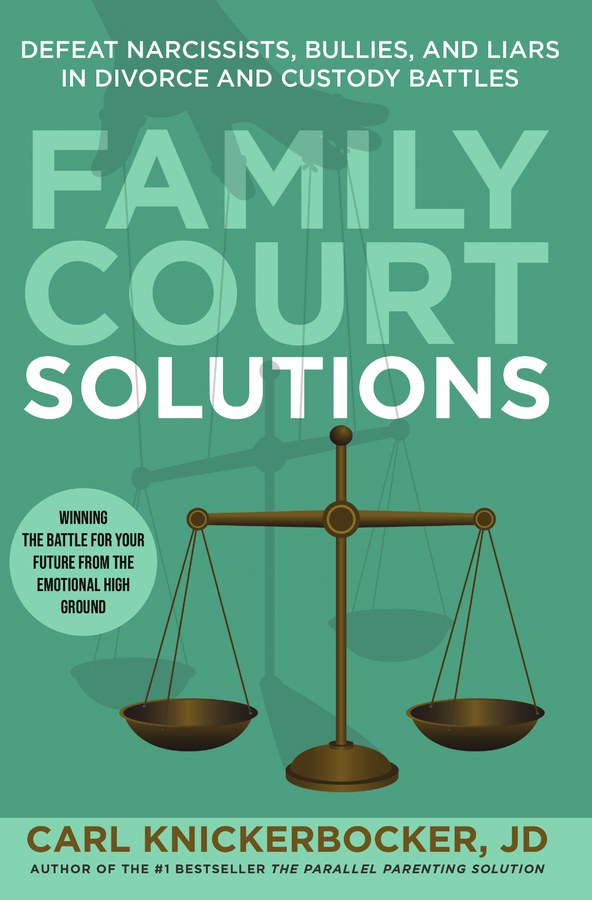
This article is adapted from Family Court Solutions by Carl Knickerbocker, JD — the therapist-recommended, attorney-written guide to defeating narcissists, bullies, and liars in divorce and custody battles.
Get the Book