Documentation is the spine of every high-conflict family law case. The protective parent with the better documentation almost always has the better case — not because documentation wins arguments on its own, but because it makes the entire dynamic of the case legible to the people who will decide it.
That said, "more documentation" is not the goal. Useful documentation is the goal. A lot of well-meaning protective parents bury themselves in records that hurt their case, while missing the records that would have helped. This article is about the difference.
What documentation is for
The purpose of documentation is to allow a stranger — a judge, a GAL, a custody evaluator — to see your case the way you see it, supported by contemporaneous records they have no reason to question.
That framing matters. Documentation is not for you. You already know what happened. Documentation exists so that someone with no prior knowledge of your family can evaluate your version of events against the available evidence and conclude that your version is more likely the correct one.
Every choice about what to document, how to document it, and how to organize it should run through that filter. Will this help a stranger see what happened? If yes, keep it. If no, don't.
The records that matter
Communications between the parents
Every text. Every email. Every co-parenting app message. Every voicemail. Captured in their original form, preserved by date, organized chronologically. This is the foundational evidence in essentially every high-conflict case. Move all communication to a documented channel. If your ex insists on calling, send a written follow-up to every call summarizing what was said.
Schedule and exchange records
Pickup and drop-off times. Cancelled visits. Late returns. Refused exchanges. Schedule modifications and who proposed them. Most parents do not maintain this consistently — and a year of consistent exchange records, dryly presented, is one of the most persuasive evidence sets a judge will see.
Medical, school, and provider records
Pediatrician notes. Therapist contact records (with signed releases). Report cards. Attendance records. Sign-in sheets at school events. These records are powerful precisely because they were created by neutral third parties, not by you. They cannot be dismissed as your interpretation.
Photographs — sparingly
Photos of injuries, of unsafe conditions, of significant events. Not photos of every minor irritation. The protective parent who shows up at the hearing with 400 photos of trivial moments looks obsessive. The one who has 12 well-chosen photos of consequential moments looks credible.
Your own contemporaneous notes
A simple journal — date, time, who, what happened, what was said. Created in real time, not reconstructed later. These are not as powerful as third-party records, but they fill in the gaps and demonstrate consistency.
The records that don't
Long emotional emails to your ex
Anything you wrote in pain, in fury, in panic, or in three-paragraph self-justification at 11pm. These will be read aloud at trial — by the other side — and they will hurt you. If you wouldn't be comfortable with the judge reading it word-for-word, do not send it.
Social media commentary about your ex
The vague subtweet. The cryptic Instagram caption. The supportive friend's comment. The shared meme about narcissists. All of it is discoverable. All of it will be screenshotted and submitted in the worst possible context. None of it helps your case. Stop posting.
Recordings made in violation of your jurisdiction's law
One-party-consent rules vary by state. Recording without legal authorization can get the recording excluded, get sanctions imposed, and in some states get you criminally charged. Talk to your attorney before recording anything.
Hearsay from your supportive friends and family
Your sister's opinion that your ex was always controlling, your friend's recollection of what your ex said at a barbecue in 2019, your mother's view of who is the better parent — these are not the evidence your case needs. Your supportive network is for emotional support. Save the actual fact witnesses (teachers, neighbors, doctors) for the evidence file.
Endless analysis of your ex's psychology
The 30-page document analyzing your ex's narcissistic patterns, with citations. The detailed personality breakdown. The amateur diagnosis. None of this belongs in the case file. It is not admissible, it makes you look obsessed, and it distracts from the documented conduct that is admissible.
How to organize it
The organizational system matters almost as much as the content. A judge will not read 800 pages of unsorted records. Your attorney will not be able to find the right text message in a six-month thread the night before trial.
Chronological master index
A single spreadsheet or document, sorted by date, listing every documented incident with a one-line description and a reference to the underlying record. This is the working index that lets your attorney find evidence on demand.
Source-of-truth folders
Original records preserved in their native form — full text message exports, full email threads, full PDFs — in clearly labeled folders. Never edit a source record. Never crop a screenshot in a way that loses context. Authenticity is everything.
Topic files for issues that recur
If exchange problems are a recurring issue, all exchange-related records live in an exchange folder. If medication management is a recurring issue, all medication-related records live in a medication folder. The topic files cross-reference back to the chronological master index.
The discipline
Documentation is a habit, not a project. The protective parent who builds the file in real time, week by week, ends up with the kind of evidence base that makes their case nearly self-presenting. The protective parent who tries to reconstruct everything the month before trial ends up with gaps, inconsistencies, and a stack of records too disorganized to be useful.
Build the habit early. Maintain it without drama. By the time the case actually needs the file, the file will be ready.
Want the full playbook?
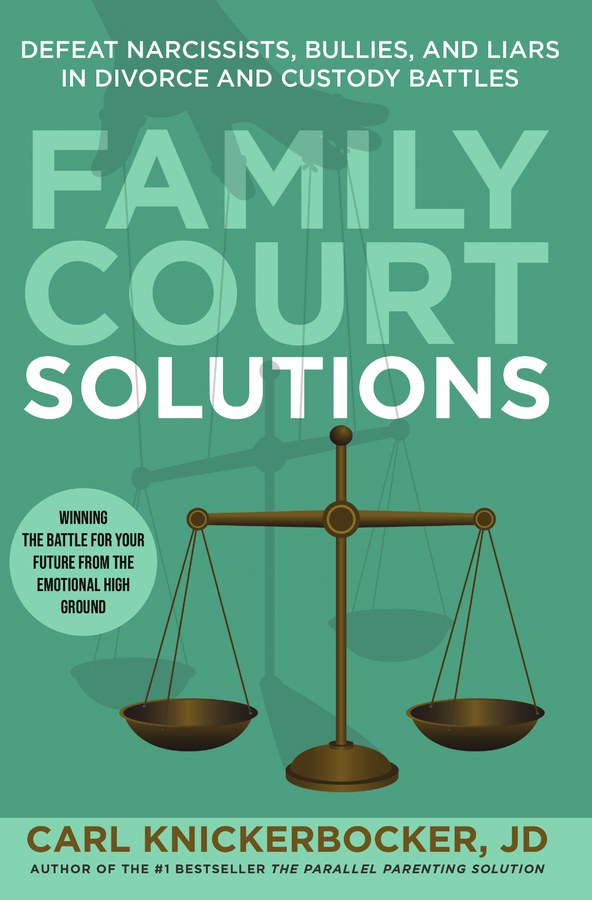
This article is adapted from Family Court Solutions by Carl Knickerbocker, JD — the therapist-recommended, attorney-written guide to defeating narcissists, bullies, and liars in divorce and custody battles.
Get the Book