"High-conflict personality" has become a buzzword in the divorce world. Like most buzzwords, it gets used so loosely that it loses most of its meaning — and most of its strategic value to the people who actually need it.
So let's set the buzzword aside and define the term the way it's meant to be used: as an operating description of how somebody behaves in conflict. The label is not a diagnosis. You are not the right person to diagnose your ex with anything, and a courtroom is the wrong place to try. What you can do — and what matters — is recognize a pattern of behavior so you can stop responding as if you were dealing with someone who isn't displaying it.
The operating definition
A high-conflict personality (HCP) is someone whose behavior in disputes consistently escalates the dispute rather than resolves it. For an HCP, the goal of the conflict is the conflict.
That sounds abstract. In family court, it looks like this: every "compromise" they agree to becomes the new floor for the next round of demands. Every accusation against them gets recycled back at you in the next filing. Every successful mediation produces a fresh complaint two weeks later. Every hearing is followed by a new motion. Every step toward resolution is met with a step back into chaos.
If you've spent any time in a contested family case with an HCP, that paragraph just described your last six months.
Three loose subtypes
HCPs come in shapes. The categories overlap freely, but the patterns are recognizable.
Narcissists
Organized around an inflated self-image. Demand validation. Cannot tolerate criticism. Project their own conduct onto others. In court, drive unrealistic asks — full custody with no visitation, asset claims with no basis, indignation when the law doesn't deliver the outcome they "deserve."
Bullies
Use aggression and intimidation to bulldoze the system. Talk over their attorneys. Threaten witnesses. Accuse the judge of bias. File punitive motions designed to exhaust rather than win. Their tactic is volume and pressure, not persuasion.
Liars
Weaponize gaslighting, false allegations, and shifting narratives. The story changes to fit whatever helps in the current exchange. The 2019 incident gets re-narrated each time it comes up. Documentation is contradicted, then re-contradicted, then re-narrated again. They're betting on the cumulative confusion rather than any one false claim.
Most HCPs in family court blend all three.
Why the diagnosis question is a trap
A lot of protective parents get stuck on whether their ex is "really" a narcissist, "really" has Cluster B traits, "really" qualifies for a personality-disorder diagnosis. This is a trap. Not because the question is unimportant in the abstract — it can matter a great deal in clinical settings — but because in your case, it's largely beside the point.
You are not going to get a diagnosis admitted in court. The opposing party is not going to sit voluntarily for a clinical evaluation. Your therapist cannot diagnose someone they have never met. Even if you somehow obtained a diagnosis, judges are typically reluctant to weigh psychiatric labels heavily in custody decisions. What courts actually evaluate is conduct.
This is why the operating definition matters more than the clinical one. You don't have to prove your ex has narcissistic personality disorder. You have to document, repeatedly and credibly, the behavior. Behavior is admissible. Behavior is observable. Behavior is what custody decisions get built on.
What changes once you've named the pattern
Once you stop trying to "communicate better" with someone whose communication is itself a weapon, three things change immediately.
You stop expecting good faith
The single biggest energy drain in high-conflict family law is repeatedly expecting the other side to behave reasonably and being repeatedly surprised when they don't. Once you've named the pattern, that surprise stops. You can plan for what they're going to do because they're going to do what they always do.
You stop arguing your case to them
HCPs are not your audience. The judge is your audience. The GAL is your audience. The custody evaluator is your audience. Once you stop trying to convince your ex of anything, you free up enormous bandwidth to build the actual record that the people deciding your case will actually look at.
You start using their tactics against their case, not yours
HCP behavior, when documented and presented patiently, is one of the most damning things a judge can see. The grandiosity. The contempt for the other parent. The inability to accept any accountability. The shifting story. These traits do not play well from the witness stand. With the right preparation, your ex's HCP behavior in court becomes the strongest evidence in your file.
The strategic implication
The standard family law literature was written for two reasonable adults working in good faith. Your case is not that case. Following standard advice in a case it wasn't written for — "communicate better," "be flexible," "meet them halfway," "don't escalate" — will not just fail. It will hand the other side leverage, every time.
Recognizing what you're dealing with is not labeling your ex. It's giving up an inaccurate model of your case so you can adopt the accurate one. Every chapter in Family Court Solutions proceeds from that single move.
Want the full playbook?
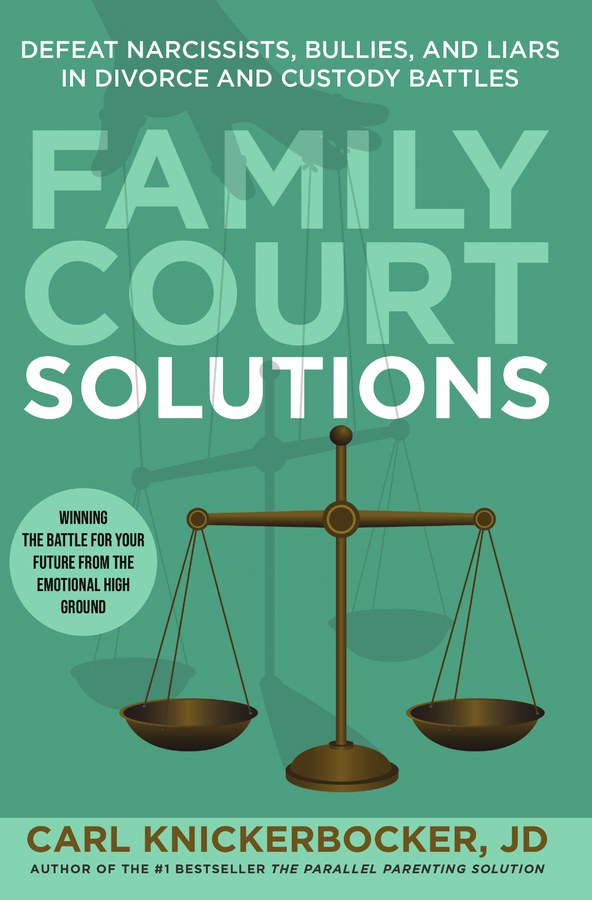
This article is adapted from Family Court Solutions by Carl Knickerbocker, JD — the therapist-recommended, attorney-written guide to defeating narcissists, bullies, and liars in divorce and custody battles.
Get the Book