A smear campaign is one of the most painful tactics a high-conflict ex can deploy. The campaign typically unfolds in parallel with the legal case, targeting your reputation with mutual friends, family members, the children's school community, professionals involved in your case, and, increasingly, on social media.
The instinct to defend yourself is overwhelming, justified, and almost always counterproductive. This article explains why the campaign is happening, why defending yourself in kind usually backfires, and the disciplined response that turns the campaign itself into evidence.
Why HCPs run smear campaigns
Several functions, often simultaneously:
Reality control
The HCP needs the external world to confirm their version of events. If everyone in their orbit agrees you are the villain, their internal narrative is preserved. This is partly strategic and partly psychological — for some HCPs, the campaign is not consciously calculated; it is the natural way they process an ego threat.
Isolation
Stripping you of your support network. If your mutual friends side with them, you have one fewer source of help. If your family is questioning your version, you have one fewer safe place to land. If the children's school treats you with suspicion, your access to information about the children is constrained. The campaign is, among other things, isolation strategy.
Pre-poisoning the witness pool
The people the HCP is talking to may end up as collateral witnesses in your case — or, more commonly, they will show up as character witnesses for the HCP. The campaign is, in part, witness conditioning. By the time anyone interviews them, they have been hearing one side of the story for months or years.
Preemptive defense
If the HCP can establish in advance that you are unstable, untrustworthy, abusive, or whatever framing they prefer, then your eventual accurate description of their behavior becomes "obviously a lie consistent with the unstable picture." The smear preempts your truth.
Triangulation against the children
In severe cases, the campaign reaches the children. The kids overhear conversations. They are told things directly. The smear campaign and parental alienation overlap heavily.
Why direct rebuttal usually backfires
Almost everyone targeted by a smear campaign wants to fight back — to call the mutual friends and explain, to post their own version on social media, to send long emails to the relevant family members. This rarely helps and frequently hurts.
You match the escalation pattern
The HCP's posts are now your posts. The HCP's mass emails are now your mass emails. To anyone watching from the outside, the conflict looks symmetrical. The "both sides are crazy" framing — which is exactly what you most need to avoid — gets locked in.
You make yourself the topic
Healthy people in stable lives do not talk about their exes constantly. The protective parent who is conducting their own counter-campaign starts to look like a person whose life is consumed by the conflict. The other parent, paradoxically, can look like the more stable one — "they don't seem to be obsessed with this the way she is."
You produce ammunition
Every emotional post, every angry email, every defensive text becomes an exhibit. The HCP screenshots everything. Six months later, in court, you are confronted with the campaign you yourself ran.
You convince almost no one
The people who already believe you don't need convincing. The people in the HCP's camp won't be convinced by your defensive posting; they will read it as proof of your dysfunction. The neutral parties don't want to be in the middle. There is almost no audience for whom direct rebuttal is the right move.
The disciplined response
Live the alternative
The smear campaign is making a claim about who you are. The most powerful counter is to be, observably, over time, not that person. Stable. Calm. Child-focused. Engaged with your work, your community, your routines. Not consumed by the conflict. People with eyes will eventually see the gap between the smear and the reality.
Maintain your important relationships, quietly
Stay in steady, light, non-conflict-focused contact with the people who matter to you. Family. Trusted friends. Don't centerpiece them around the case. Don't recruit them to your side. Don't ask them to "choose." Just be present in their lives as the person you actually are. This is more persuasive than any argument.
Restrict your audience
You don't owe an explanation to everyone. The mutual friend who reaches out concerned about "what they're hearing" gets a brief, calm acknowledgment: "I'm aware of the situation. It's been hard. I'm focused on the kids and on what comes next. I'd rather not get into it." Then change the subject. Most reasonable people will respect that. The unreasonable ones were never going to be your allies anyway.
Don't post about the case on social media
Not vaguely. Not strategically. Not at all. No subtweets. No cryptic captions. No memes. No posts of you "thriving" pointedly. No supportive friends' comments. If you cannot resist the impulse, lock down or delete your accounts for the duration of the case.
Limit your digital trail
Reasonable privacy across the board. Be careful about location-tagged posts. Consider whether to maintain dating-app profiles during litigation. Assume everything publicly visible will be screenshotted and submitted.
Document the campaign
Where the smear surfaces — emails sent to mutual contacts, social media posts, things said to professionals — document it. Screenshots. Dates. Sources. This collection becomes useful in the case, both as evidence of the other side's conduct and as context for the false statements that may appear in their filings.
Identify the witnesses they're poisoning
The smear campaign tells you who the HCP plans to use as witnesses. The person they're feeding their narrative to is the person they will later subpoena or designate. Knowing this lets you prepare your attorney to deal with them effectively at trial.
The exception: targeted correction
There are narrow circumstances where a measured, professional correction is the right call — usually involving professionals whose interactions with you would be substantially compromised by an uncorrected false impression.
Examples: if the HCP has told your child's pediatrician something specifically false about you that affects how the doctor interacts with your child or you, a brief written correction may be appropriate. If a teacher has been told something false that's now affecting how they treat your child, a brief written correction may be appropriate. If a GAL or evaluator has been told something demonstrably false that's affecting their evaluation, this gets escalated through your attorney.
In each case the correction is: brief, factual, professional, not attacking the other parent, sticking to the specific point that needs correcting. Not a comprehensive case against your ex. Not an unloading of grievances. Just a calm professional statement of the relevant fact, ideally with supporting documentation.
The long view on relationships
Some relationships will not survive the smear campaign. People who you thought were your friends will side with the HCP. Family members may distance themselves. This is genuinely painful, and there is no version of it that doesn't hurt.
The relationships that do survive are usually the ones worth keeping. Most protective parents emerge from a smear-campaign period with a smaller but more authentic support network. People who chose you despite the campaign chose carefully. People who left would have left eventually anyway.
The campaign will end. The case will end. The people who matter to you will, mostly, eventually see what was actually happening. Your job in the meantime is to stay the person they will recognize when they do.
Want the full playbook?
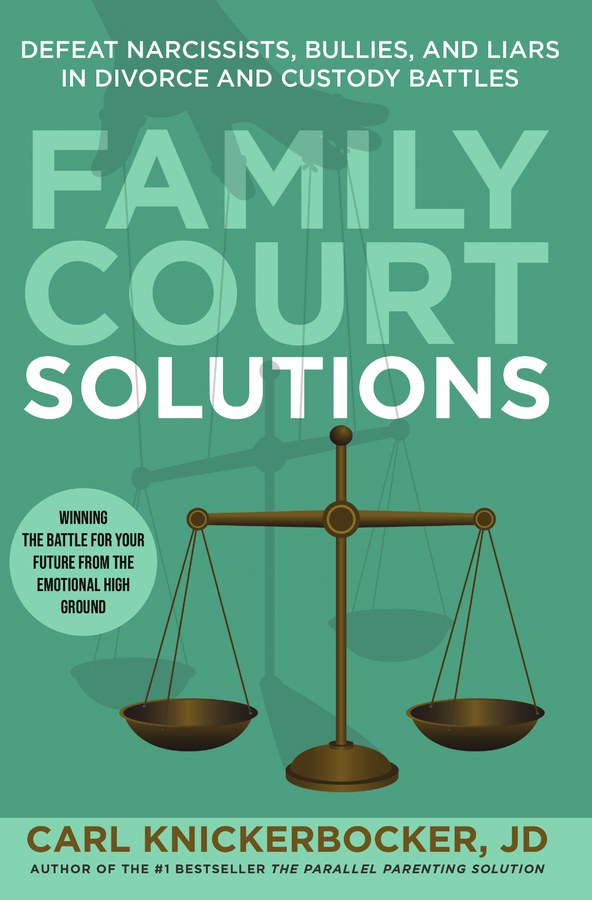
This article is adapted from Family Court Solutions by Carl Knickerbocker, JD — the therapist-recommended, attorney-written guide to defeating narcissists, bullies, and liars in divorce and custody battles.
Get the Book